Kibembe: Our Heritage Language
There is something quietly extraordinary about hearing a group of young people in Greater Manchester — children who have grown up attending British schools, listening to British music, and navigating British life — speaking Kibembe. It is the sound of a people choosing not to forget. It is the sound of M’Mbondo Manchester doing what it was built to do.
What Is Kibembe?
Kibembe is the mother tongue of the Babondo people — a Bantu language spoken in the Fizi and Itombwe territories of South Kivu Province in the Democratic Republic of Congo. Like all Bantu languages, Kibembe is characterised by its rich system of noun classes and verb extensions, and its words carry cultural meaning that often cannot be directly translated into English or French. To speak Kibembe is not only to communicate — it is to think in a particular way, to carry a particular worldview.
For the Babondo diaspora in the UK, Kibembe represents a connection to homeland, family, and identity that no other language can replicate. When grandparents and grandchildren can speak to each other in the language they share — across two continents and two generations — something profound is preserved.
“When our children speak Kibembe, we know our roots are still alive.” — M’Mbondo Manchester community elder
Teaching Kibembe in Manchester
M’Mbondo Manchester actively supports the preservation of Kibembe through informal language sessions for young people, cultural education workshops, and intergenerational learning — where elders and children come together, and the language flows in both directions.
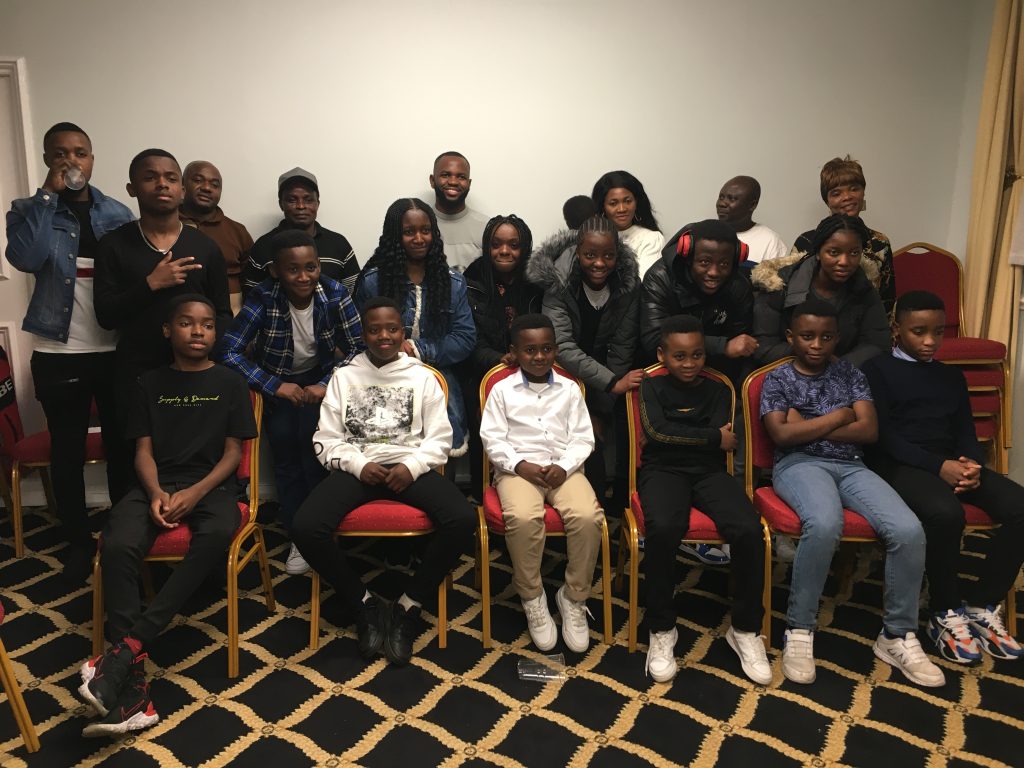
In 2023, we held a landmark Kibembe language session at Britania Hotel in Manchester, bringing together youth and elders from our community. The young people in that room — many of them born or raised in the UK — learned greetings, phrases, songs, and stories in their heritage language. For many, it was the first time they had been formally taught Kibembe outside the home.
Why Language Matters
Language is not merely a communication tool. It is the vessel that carries culture, values, memory, and identity. When a diaspora community loses its mother tongue across generations, it loses something that cannot be recovered by any other means. The stories, the proverbs, the songs, the ways of expressing emotion and relationship that exist in Kibembe — these are irreplaceable.
M’Mbondo Manchester is committed to ensuring that Kibembe-speaking young people grow up proud of their linguistic heritage, and that UK-born Babondo children have the opportunity to learn it — not because they must, but because they deserve the chance to know who they are in the fullest possible sense.
Kiswahili: Our Shared Language
Alongside Kibembe, Kiswahili holds an important place in our community. Kiswahili is one of Africa’s great lingua francas — spoken by over 200 million people across East and Central Africa, and the official language of several countries bordering the DRC including Tanzania, Kenya, Uganda, and Rwanda. For many Babondo families, Kiswahili is the language of wider connection — the language used when speaking with neighbours, trading partners, and communities beyond one’s own.
At M’Mbondo Manchester, we embrace Kiswahili as an additional community language. Our materials, activities, and communications are available in both English and Kiswahili, and we use it to bridge communication within our diverse community and with partner organisations across Greater Manchester.
But it is important to be clear: Kiswahili is a language of communication and connection, while Kibembe is a language of identity and soul. Kibembe is the language in which our ancestors told stories, sang songs, and expressed the values that define us as Babondo people. It cannot be replaced by any other language, however widely spoken. Preserving Kibembe is not a practical task — it is a cultural duty, and one that M’Mbondo Manchester takes seriously.